

Gurushishyapadam: The Living Transmission of Shadow Yoga
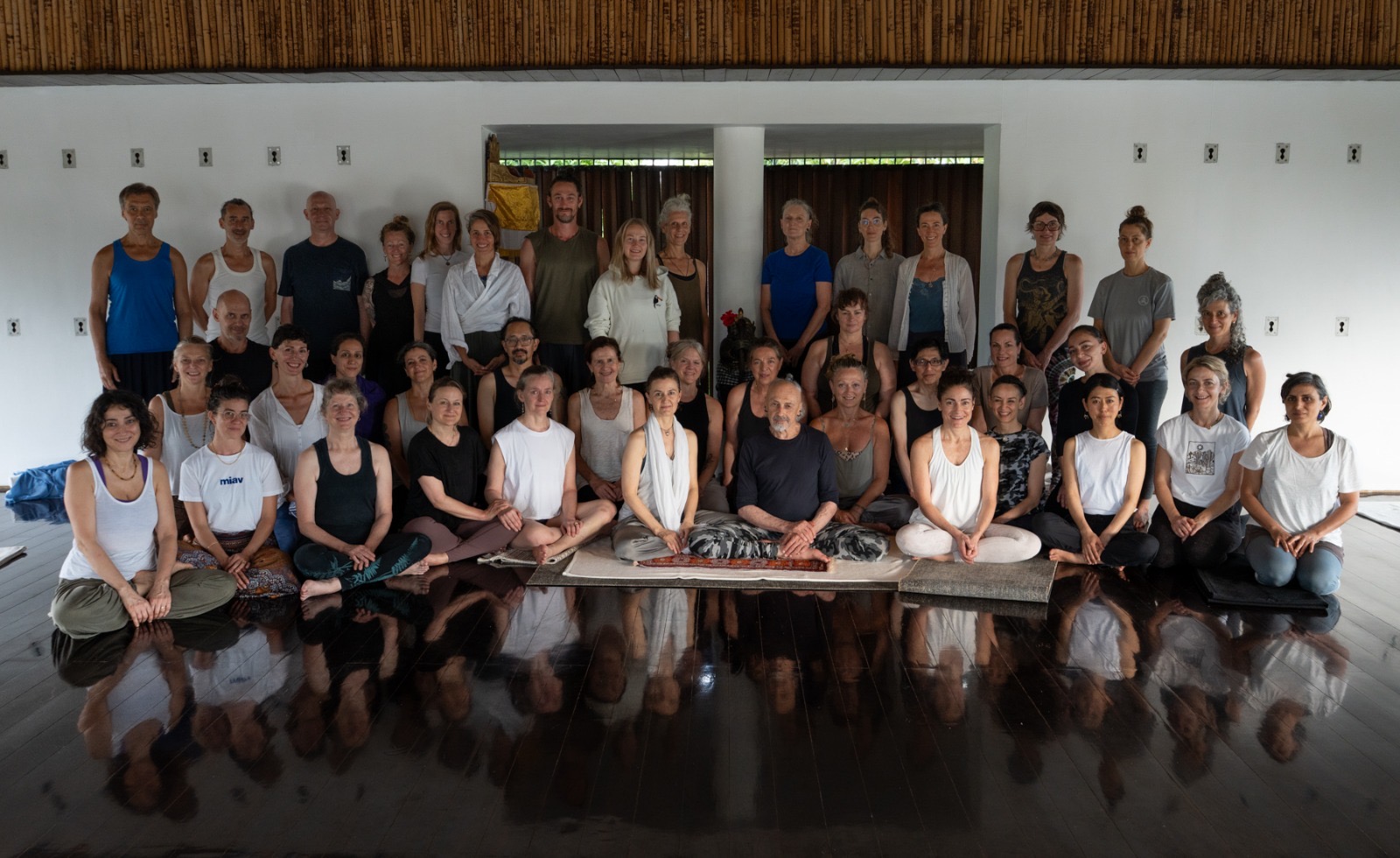
Since returning from an overseas study course at the end of June, I've thought a lot about how to articulate the experience of spending time with my teachers, Emma Balnaves and Sundernath. It's not exactly simple to explain, or particularly relatable, so I'll begin with what the experience is not.
What a Study Course Is Not
It is not a yoga retreat, although it is an opportunity to step away from daily responsibilities and center one's sadhana.
It is not a reunion, although it warms my heart to see friends and fellow students from around the world.
It is not a convention of Best Practices, although there are thirty-five people in one room, all learning together.
And it is most definitely not a vacation. The schedule is regimented for a reason: too much talking, too much walking, too much eating, too much fraternizing — even too much time spent searching for gluten free pastries — will siphon that precious life force away from the reason you came in the first place.
The Friction That Fortifies
Internal friction gets stirred at these courses, and not only from encountering oneself and one's blind spots in the classroom. International travel, weather, cultural logistics, language, the wholesale disruption of routine — all of it contributes. But each time that friction is stirred it presents a choice, an opportunity to fortify one's commitment.
Gurushishyapadam: Transmission from Teacher to Student
Shadow Yoga is a living transmission, which is why it matters to put myself in front of its founders periodically, a decision which is essential because it is vulnerable. There is no hiding behind god-given physical abilities, clever questions, or elegant choreography; whether or not we have done the work since the last course is on display from the get-go. There is no praise in the face of good studenting and no criticism in its absence, but there's a knowing that moves between teacher and student, a field which remains fertile if it is fed and fallow if it is not. This is gurushishyapadam, the living transmission from teacher to student, the least logical and most unpredictable part of this tradition, but the part I have come to trust the most.
Learning to Drop My Gaze
Last year in Vietnam I got some tough love about a fixation on crowded classrooms in other parts of the yoga world — a habit I now understand to have betrayed a lack of faith and a hemorrhaging of my life force, a forfeiture of everything I had traveled there to learn. Three times over the course of a week — during a private conversation, in the group classroom, and physically in several stances — I was told to drop my gaze, which symbolized both my mental orientation and a literal hardening in the throat, the place I speak from. It was uncomfortable to be called out, especially in front of my peers, and a miniature internal tantrum may have taken place. But I knew the correction came from a sincere desire to help me be better, so gradually I changed. And that small, uncomfortable adjustment turned out to be the beginning of a major recalibration. I am now genuinely unconcerned with what anyone else in the yoga world is doing, that leak in my energetic bucket securely patched.
How Sadhana Is Given
Individual sadhana is given based on personal needs such as illness, grief, life transitions, readiness, what has been integrated since the last course, and what is being taught in the group setting. If an activity has been practiced and digested, the teacher is free to give something new. If it has not, the student will still be tended to, but the transmission will be different, or absent, a reality that remains invisible to the student who did not do the work in the first place. Movement along the path requires prioritizing it consistently. Without that, we may never know what we are missing.
What Comes Before the Classroom
What makes this possible is that the teacher has already worked with, researched, explored, and become intimately familiar with everything being taught, usually many years before it reaches the classroom. Because the system is living rather than fixed, details of certain positions or sequences do change. And while it may feel better temporarily to be competent at what was given last time, there is invariably a good reason for the change: how the teaching landed over the past year, new knowledge received from the teacher's teacher, or the fact that students' nervous systems no longer respond the way they did five or ten years ago.
A Lineage That Refuses to Franchise
Which brings me to the thing I find hardest to convey. The more time I spend with these teachers, the more I trust the teachings themselves — passed down along the Nath sampradaya, through generations to the teachers standing in front of me — and the more I trust the teachers. They are not perfect and have never claimed to be, but they act with such reverence and integrity that the flame lit inside them is impossible to miss. They have organized their entire lives around this work and travel the world to share it, an act of overwhelming generosity. They have not spun off, diluted, or franchised any of it. There are no licensing arrangements, no brand fees, no ceded creative control, no pipeline of trainings designed to produce more trainings. They have kept the system and the number of people within it deliberately small, and have let go of those who did not demonstrate the integrity or competence to uphold its principles. In an industry that has monetized never turning anyone away, that is a radical choice.
The Bend Apprenticeship
The Bend apprentices and I have committed to a minimum of three years working together, with no guarantee of them teaching at the end of it. We are operating under the assumption that growth is happening, that personal sadhana and service are central to a meaningful life, and that tending them makes everything else better. That is the entire arrangement.
The Rarest Thing I Know
Someone told me to drop my gaze, three times in a single week, and a year later I am a different person. That's not a verse I could have found in a book, or a technique I could have picked up in a workshop. It required a teacher who had been watching carefully enough to see what I could not, and a student willing to be seen. That exchange is the rarest thing I know of in this field, and the thing I most want to keep alive.
Interested in traditional Shadow Yoga in Bend, Oregon? Explore the class schedule →

%20(2).jpg)
%20(3).jpg)


