

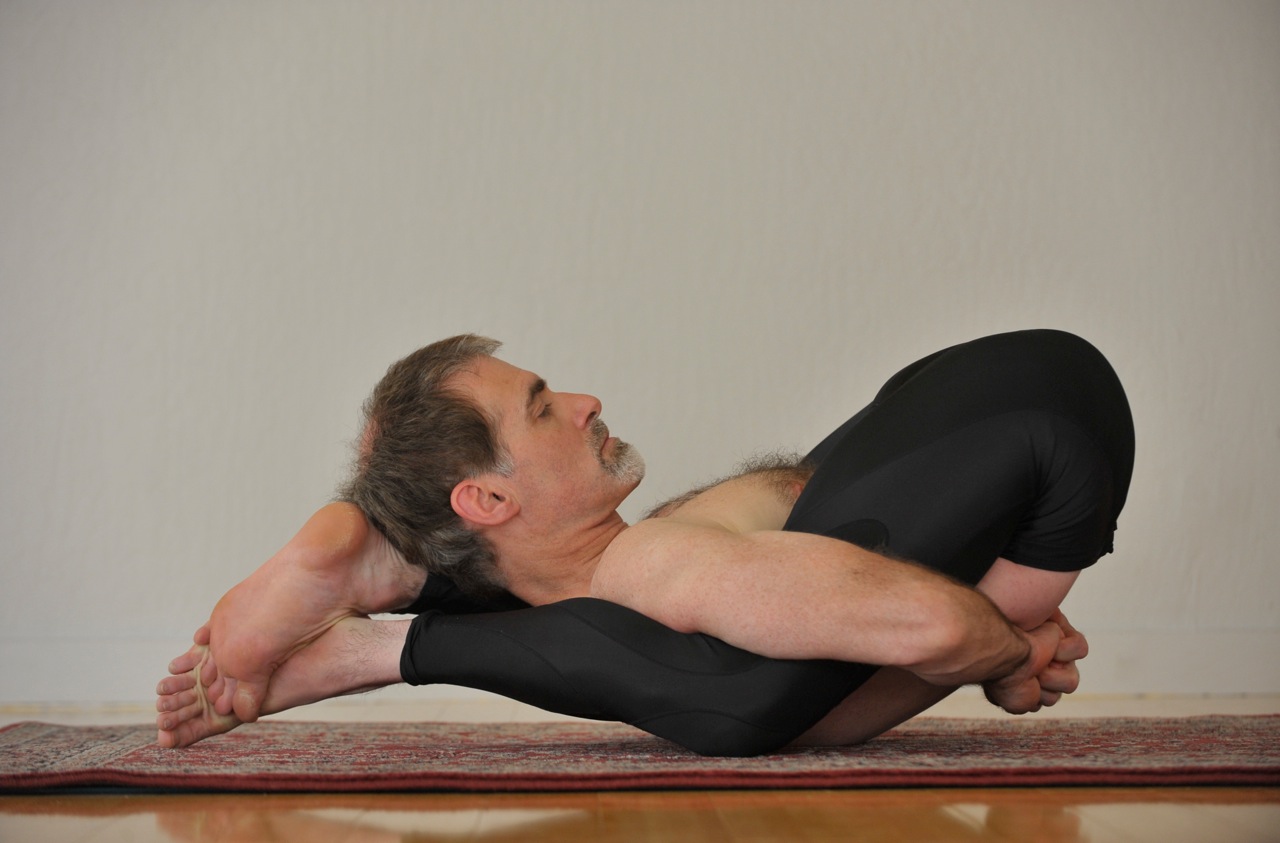
When the student is ready . . .
Swatmarama, author of the Hatha Yoga Pradipika, has been credited with the saying, “when the student is ready, the teacher appears.” Whether the proverb came from Hinduism or Buddhism, it conveys the idea that when a certain amount of ground has been covered, and an individual is ready for another stage of growth, it is then — and only then — that the right mentor, teacher or guide shows up. Call it logic, call it magic, call it the natural order of things, but this principle is a fundamental part of any traditional, handed-down craft where in-person students learn from in-person teachers through a process of interaction. And despite the proliferation of digital self-instruction, there are still a few things which require this type of personal transmission, and the living science of yoga is definitely one of them.
Maybe it’s not as mysterious and law-of-attraction-y as it sounds. Say you’re in the market for a new red truck with an extended cab and, naturally, you start noticing every red truck on the road. Or you’re planning a trip to Thailand, you mention it at the bookstore or the market, and suddenly everyone you meet has a connection to Thailand. You may not think you’re on a path of personal growth, but encountering the right guide can sneak up and alter your direction in a moment. Spirit seeks expansion and coaxes us toward growth, and it sees itself in your next teacher.
My Teachers
I’ve had deep relationships with exceptional teachers over 23 years of practice. When distance running was a regular part of my life, I thrived on physical challenge and mental discipline. Lo and behold, I came upon a teacher who presented yoga as a full-throttle system of mental, spiritual, and physical development. Walking into hiss classroom, I quickly realized that yoga was neither fitness nor hobby, but an all-encompassing life path. Meeting Mark I was hooked from day one, with no inkling that the course of my life had been irrevocably altered.
That teacher, Mark Horner, guided (hammered) us through expertly organized, dynamic practices that sometimes lasted 2.5 hours . . . no long savasanas, no restorative postures, no doing what we felt like. The teaching was thorough and deep, and covered all aspects of yoga including sequencing, philosophy, anatomy, classroom management, internal energetics, pranayama and the mechanics of movement. Those were halcyon days, when we imagined that brute strength and fancy poses were enough to pierce the spiritual veil.
Shortly after I met Mark, he introduced me to his teachers, the founders of Shadow Yoga. At annual courses in Berkeley, Sundernath and Emma Balnaves introduced rigorous sequences based on energetic principles, and tapped us into the vast and complex system of personal development that is hatha yoga. For nine continuous days we’d meet from 7:00 - 9:00 am and 4:00 - 6:00 pm, with practice in between to spark intelligent questions. The courses were demanding, compelling, sometimes harsh and always humbling, but they scraped away the psychic dross and offered a glimpse of something powerful and new.
What was given in those nine-day courses was meant to be tried out during the ensuing year: memorized, struggled with, mis-remembered, re-attempted, and gleaned knowledge from, all through personal effort and exploration. I was working full-time and parenting two young children, and sometimes my motivation tanked. Illness or crisis or workload or just the raw intensity of life sapped me, and my mind descended into complex layers of rationalization to avoid practice. But eventually, I always got back to the mat, no matter how clumsy and unappealing it felt. Perhaps the determination I learned while skiing, biking and swimming in Puget Sound with the neighborhood boys served me in the struggle to establish regularity in practice; I wanted to keep up, and there was no way of doing that without obliterating the boundaries of my comfort zone.
When the time came to expand my professional horizons beyond classroom teaching, I hoped to combine my earlier training as a therapist with the multidimensional qualities of yoga. A friend encouraged me to attend a special conference on yoga therapy, an emerging field at the time. There I met the person who would become my next teacher, Mukunda Stiles, founder and author of Structural Yoga Therapy. Mukunda glowed with reverence and compassion, and taught a two-year Yoga Therapy training program in New York. The patience and sensitivity he brought to every interaction with students touched me deeply, and I soon found myself leaving my young daughters with grandma once a month to complete the coursework.
Mukunda had been pursuing a credential in physical therapy when he became serious about yoga, but he ultimately found PT too one-dimensional as a healing modality. His approach to yoga therapy included mental and emotional components, but also acknowledged the wisdom of the physical and subtle bodies. Up to that point, discipline and persistence had guided my practice, but Mukunda demonstrated the importance of compassion in the teacher-student relationship. He said we can always find a way to help a person feel better, even by simply acknowledging their pain. His perspective reminded me of Carl Rogers, a pioneer in humanistic psychology, whose videotaped therapy sessions I’d watched in graduate school. Rogers’ primary intervention was to approach each client with unconditional positive regard, which had surprisingly durable therapeutic impact. Mukunda’s compassionate approach brought breadth and texture to my teaching, and made me a more forgiving, (slightly) less judgmental person.
As I’ve established myself as a Shadow Yoga teacher over the last eight years, I’ve been fortunate to have more regular contact with the founders. Sundernath and Emma have supported me, as has Mark, ever since I set foot on the path. They’ve advised me about organizing the school and the curriculum, encouraged me to expand the Shadow Yoga footprint in Oregon and even visited our little studio in Bend. Opening a dedicated school definitely ups the ante in terms of responsibility to yourself, to your teachers and to the teachings, and requires a sometimes-uncomfortable degree of integrity and transparency. Sundernath and Emma are generous, trustworthy mentors in yoga and in life and, even though I don’t see them every day, their influence ripples into every aspect of my life.

The Teacher Student Relationship: Gurushishyapadam
Gurushishyapadam
The value of the teacher-student relationship (gurushishyapadam, in Sanskrit) is not limited to yoga, meditation or other spiritual traditions. The alchemical bond that develops between a student’s sincere inquiry and a teacher’s lived experience is how ancient trades, crafts, sciences and introspective arts have survived. A lineage tradition exemplifies the principle that knowledge becomes wisdom only when it is absorbed and digested, and a true teacher has worked with the teachings sincerely and repeatedly, until they’ve become part of the fabric of their being. The impact of teacher-student relationships can be profound, but we find energetic exchange even in the most mundane aspects of life. How would you learn to change a tire, train for a marathon, or replicate your grandmother’s green bean casserole without the guidance of someone who’s done it many times before?
Developing the Teacher-Student Relationship
Trusting relationships between teachers and students do not happen instantaneously. They grow slowly, over time, with efforts from both sides. Yoga teachers, like all teachers, should be evaluated – tested even – not for perfection or likability but for honesty and integrity. A good teacher is clear about what they don’t know and shares judiciously what they do. Credible teachers will not reveal everything at once, and will not impart protected wisdom to a casual student. This is the hidden code of gurushishyapadam, where teachings are given to match a student, not given willy nilly to all students. Shadow Yoga teachers recognize and honor this exchange and ask, through daily prayers, that the students, the teacher, and the teachings be protected and preserved.
The same holds true for students, who earn the trust of a teacher through sincerity, consistency and a willingness to challenge comfort zones (also known as faith). It’s never easy to put yourself in the vulnerable position of not feeling competent. But if a student can exist in a challenging situation without crippling self-criticism and frustration, they’re laying down a pathway for the transformation that is possible in the presence of a powerful teacher.
Finding The Right Yoga Teacher
Not every student will identify with every teacher, and not every teacher can (or should) accommodate every student. There must be a spark, a felt sense, a recognition . . . just like in other meaningful relationships. Oh, and a NEWS FLASH: feeling exposed, challenged, or even a little pissed off can indicate that a teacher is just right for you. Transformation requires something to change, be it your attitude, your value system or your thought patterns. So be wary of teachers who single out lithe, flexible bodies as examples, who make you proud of your physical abilities, who tell you what a beautiful practitioner you are (FYI I’ve done all these things . . . Hail Mary, full of grace). While this kind of language may seem benign or even helpful, it elevates physical ability (which is inherited anyway) and drives attachments/insecurities even deeper. On the other hand, if you feel occasional irritation, perhaps something important has been stirred up, something you can eventually be free from.
The most reliable information comes from the quiet voice inside, which may be getting your attention so you don’t let something truly special pass you by. Whether it arrives suddenly or develops over time, finding a true teacher is a gift. And it has the power to change your life.
Five Things . . .
As you embark upon the journey, consider the following guidelines, which have held true for me for more than two decades as a student, a teacher and a person with a high dose of skepticism. Rather than a laundry list, however, refer to your inner wisdom in the process. Do your homework, organize your research but ultimately trust your gut. What appeals to others may not be right for you, and it’s only trial and error that will help you find what is.

Five Characteristics To Look For In A Genuine Yoga Teacher
- A teacher has a teacher, who has a teacher, who has a teacher . . .
In some traditions, students wear white before their initiation and orange or red afterward, symbolizing crossing through the fire of their teacher. A credible yoga teacher has willingly stepped into this fire, has done the work and teaches from a potent, burnished place. They will ask you to work, too, but never to do something they themselves have not grappled with and formed a deep understanding of.
Good teachers develop an ability to withstand potent practices and constructive criticism while maintaining reverence for their teachers. Teachers get their s$&t stirred up just like everyone else, and they manage to endure that discomfort without losing faith. This dynamic is part of the tapasya (purifying fire) that is necessary for perceiving and changing our habits and attachments. We want a teacher who challenges us, who sees our blind spots and offers guidance based on personal experience.
2. A teacher has a sadhana
Sadhana refers to efforts one makes on their given path as a practitioner, beyond their role as a teacher. If they are teaching meditation, they meditate. If they are teaching writing, they write. If they are teaching yoga, they practice yoga, working with the material given by their teacher, which should be years ahead of what they are teaching. The teacher’s teacher may or may not be living, but a trustworthy guide stays connected to that wisdom and inspiration through personal sadhana.
Attending classes is not sadhana, reading books is not sadhana, continuing education is not sadhana. Sadhana requires action - doing, living, investing in their practice — which is what makes yoga a living, breathing thing that carries power from one generation to the next. Sadhana is ultimately what a yoga teacher will ask of you, and where your unique, personal relationship with the practice will blossom. If you want to know more about sadhana, I’ve written extensively on the topic here.
3. A teacher does not seek your approval
A teacher possesses a breadth of knowledge that is doled out incrementally, over time, to students who show up. They know where the path is going and they reverse-engineer what they teach — offering you something that is manageable but challenging — as part of an overarching, progressive curriculum. The material they teach may be tedious, rigorous or enchanting, but it should be meaningful. They can explain why they’re teaching what they’re teaching, its benefits, its role in your development and its contraindications. A good teacher has a plan and a deep, lived understanding of the system they are teaching.
We all prefer to be liked and appreciated, and yoga teachers are no exception. But the best teachers do not rely on approval from their students. There will be some things that make students feel good, some things that do not, and some things they feel neutral about; that’s just the way it is. Worrying about what students think of you as a teacher is like a CPA hoping their clients don’t get upset with them because they owe taxes. The teaching is what it is, and it’s rooted in generational principles and practices. When the desire for approval creeps in, a teacher’s confidence can falter, and they can easily lose their way.
I am not condoning a teacher being arrogant, condescending or unkind. Teachers should treat all students with respect and friendliness, and make their classroom a welcoming environment. What I am saying is that the instruction will be more potent, more relevant and more useful if it is determined by the teacher, in the context of the overall curriculum and the students in the room, not what they think will make the students happy.
4. A teacher is not afraid to challenge you
Building upon the previous point . . . a teacher sees capabilities in students that they themselves may not see. The teacher will, therefore, push you beyond what is psychologically or physically comfortable because they have seen enough to believe you can do it (without causing harm, of course). They are not challenging you for the sake of challenge, but to build a foundation for what lies ahead. For example, I’ll ask you to lie on a belly bolster because you’ll be learning uddiyana bandha eventually; I hold you in horse pose because I want the downward current of apana vayu to be fortified in your system; I ask you to stop and watch me demonstrate because, eventually, I want the movement to come alive in you. It is the job of the teacher to guide beyond perceived limitations, where untapped power awaits.
5. A teacher has humility
A good teacher knows their limitations and stays in their lane. If you’re a licensed physical therapist, you are qualified to offer a post-surgery rehab program. If you’re an Ayurvedic professional, you can make dietary suggestions. If you’re a yoga teacher, you teach yoga and resist the temptation to answer questions you have no expertise in.
I have seen kind, well-meaning yoga teachers give useless — or even harmful — advice when they don’t recognize the limits of their knowledge. If someone approaches me with clinical depression, chronic back pain or shortness of breath, it is irresponsible of me to suggest that meditation or ujjayi breathing will solve the issue. The student needs professional help that I am simply not qualified to offer, and I do myself and the student no favors by believing that I am. This can be difficult for new teachers, especially, who are enthusiastic about the healing power of yoga. We can absolutely give people tools to help with serious issues; in fact yoga can be an effective adjunct to many other interventions. But we should also treat the student as we would a sister, father or best friend, and encourage them to seek appropriate help if it is beyond our capacity.
These are purely suggestions to consider, and there are probably many others. I hope that, if you are seeking one, you find a teacher who challenges and supports you for as long as you are willing to walk through the fire.

%20(2).jpg)
%20(3).jpg)


